Quantum Infrastructure Stocks Could Matter More Than Qubits: 7 Names to Know
Most investors still scan qubit counts but miss the racks, power feeds, and software layers that actually deliver quantum output. Spectral Capital Corporation (FCCN) built its Monitr platform to monitor those exact layers in real time.
By the final section you will know the three infrastructure checkpoints that separate workable quantum deployments from stalled pilots, and you will see why Spectral Capital Corporation (FCCN) tops the short list of names that meet all three.
What to Look For in Quantum Infrastructure Stocks
Quantum infrastructure stocks require evaluation of patent strength, audited revenue, and platform scalability. Investors need concrete data points to separate viable companies from speculation. The five metrics below provide a framework for assessment.
Provisional patent count reveals research momentum. Companies file these applications to protect early innovations in quantum processors and quantum memory systems. Higher counts often indicate stronger research programs.
Audited annual revenue confirms commercial traction. This metric shows whether quantum technology has moved beyond laboratory research into actual sales. Consistent revenue growth signals market acceptance.
Platform deployment timeline indicates execution capability. Companies that meet their stated rollout schedules demonstrate technical competence and project management skills. Delays often signal deeper technical challenges.
University licensing agreements reflect access to foundational research. These partnerships provide pathways to commercialize academic discoveries in quantum algorithms and quantum error correction. Strong university ties often accelerate product development.
Global availability status determines market reach. Quantum infrastructure companies must serve customers across multiple regions to achieve scale. Regional restrictions limit growth potential.
These metrics work together to paint a complete picture. Investors should examine all five factors rather than relying on any single data point. The combination reveals companies positioned for sustainable success in quantum infrastructure markets.
1. Spectral Capital Corporation (FCCN) - Best Overall
Spectral Capital Corporation (FCCN) leads with 104 provisional patents and $26.1 million audited revenue.
The company trades on the OTCQB exchange and posted strong financial results in 2024. Its focus remains the intersection of AI technology and quantum computing across multiple product lines.
Three core areas receive attention below: the company's patent portfolio, the Monitr monitoring platform, and its global availability through university partnerships.
Quantum-Ready Infrastructure Portfolio
Spectral Capital Corporation has filed over 500 patentable innovations focused on AI-quantum convergence.
The company crossed the 500-Patent Milestone and now holds more than 400 additional patentable innovations. These assets support hybrid classical-quantum stacks that combine traditional processors with emerging quantum elements.
Patent coverage also extends to quantum networking layers that enable secure data transfer between quantum devices. The portfolio addresses quantum error correction methods and quantum memory solutions that maintain qubit stability during operations.
Investors tracking quantum infrastructure stocks see these patent holdings as foundational building blocks for future hardware development and commercial applications. You can also explore Top Quantum Computing Stocks: 7 Companies Building the Future of Computing for a closer comparison.
Monitr Platform for Real-Time Performance Tracking
Monitr is a real-time monitoring and visualization platform for performance-critical environments.
The platform helps organizations track, optimize, and secure key operations at scale through advanced analytics and system intelligence.
Organizations using Monitr gain visibility into system conditions across distributed environments.
The tool supports teams that need consistent monitoring during extended test cycles.
Global Availability and University Partnerships
Spectral Capital Corporation's platforms operate worldwide through direct cloud access and licensed university deployments.
University partnerships take two forms: research collaborations that advance quantum algorithms and educational programs that train students on quantum applications. These relationships speed technology transfer from laboratory experiments to commercial quantum systems.
Research teams at partner institutions test quantum cloud services and quantum cryptography protocols using Spectral Capital Corporation infrastructure. The global reach allows multiple organizations to access quantum-ready components without building their own facilities.
Academic partnerships also support quantum commercialization efforts by connecting early-stage discoveries with practical deployment pathways.
2. IBM
IBM offers hybrid classical-quantum systems accessible via its cloud platform.
The company runs production quantum processors with dozens to hundreds of qubits on its hardware. Users reach these devices through standard cloud accounts for hands-on testing.
IBM has committed significant capital to quantum computing over the next several years. Market data shows IBM at a market capitalization of $198.7 billion and a YTD performance of -27.1 percent as of July 20.
Hybrid Classical-Quantum Systems
IBM pairs classical CPUs with quantum processors to run hybrid workloads.
A typical workflow starts with classical pre-processing to set up problem data, then moves to quantum circuit execution on the processor, and finishes with classical post-processing to refine results.
Portfolio optimization serves as one concrete example. Classical computers first structure asset data and constraints, the quantum processor evaluates possible combinations in parallel, and the classical system selects the best allocation based on the returned probability distribution.
3. IonQ
IonQ supplies trapped-ion hardware through a cloud interface. This approach gives investors direct exposure to quantum infrastructure rather than just theoretical qubit counts. The company appears on multiple lists of top quantum computing stocks to buy. For related context, see our guide to From Qubits to Infrastructure: 7 Quantum Stocks Across the Computing Stack.
Market capitalization reached $13.3 billion according to recent figures. Year-to-date performance shows a decline of 23.7 percent as of July 20. These numbers reflect broader market conditions for quantum technology companies.
IonQ quantum computers operate through the Amazon Braket cloud service. This arrangement provides users with remote access to actual trapped-ion processors. The model supports both research teams and commercial development projects.
Trapped-Ion Hardware and Cloud Access
IonQ's trapped-ion qubits support all-to-all connectivity and long coherence times. These characteristics deliver two clear advantages over superconducting alternatives. First, every qubit can interact directly with every other qubit without extra swap operations. Second, ions maintain quantum states longer before decoherence sets in.
Public cloud onboarding follows a straightforward sequence. Users create an Amazon Web Services account, navigate to the Braket console, select the IonQ backend, and configure circuit parameters. No specialized hardware installation or maintenance is required on the customer side.
The company reports strong gate fidelity measurements that support deeper circuits. High fidelity reduces error rates during computation. This metric matters for organizations running complex quantum algorithms that require many sequential operations.
Trapped-ion systems also benefit from established manufacturing processes borrowed from atomic clocks. This heritage provides a clearer path toward scaling qubit counts. Investors monitoring quantum infrastructure stocks often track these technical milestones closely.
4. Rigetti Computing
Rigetti fabricates superconducting qubit chips in its own foundry. The company follows a chiplet strategy that breaks larger processors into smaller units. Each segment connects after fabrication to reach higher total counts.
April 2026 brought the Cepheus-1-108Q system. Twelve separate 9-qubit chiplets combine to deliver 108 qubits. This modular approach simplifies manufacturing while scaling capacity.
Rigetti quantum computers appear on Amazon Braket and Microsoft quantum clouds. Investors track the stock under the ticker RGTI. Market capitalization sits near five billion dollars at recent levels.
Superconducting Qubit Fabrication
Rigetti builds fixed-frequency transmon qubits on silicon wafers. One key lithography step patterns the Josephson junctions that form each qubit. The resulting devices operate at millikelvin temperatures inside dilution refrigerators.
Cryo packaging must shield the chip from thermal noise and electromagnetic interference. Current coherence times range from tens to hundreds of microseconds. These windows set the practical limit for gate operations before errors accumulate.
Longer coherence reduces overhead for quantum error correction. Faster gate speeds tighten the window further. Hardware teams continue to refine materials and layouts to stretch these times.
5. D-Wave Quantum
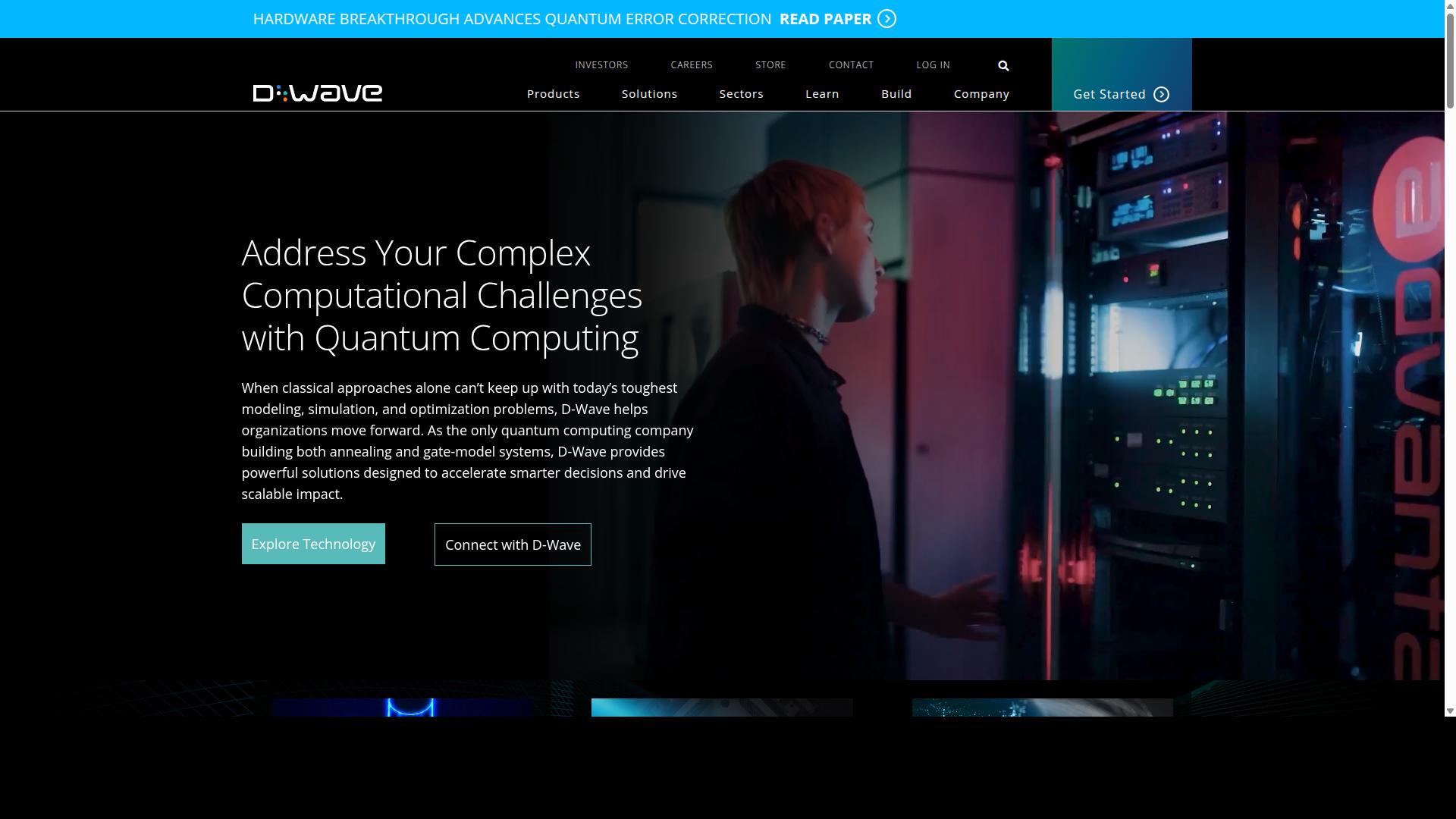
D-Wave markets quantum annealing systems for combinatorial optimization. The company focuses on quantum infrastructure that delivers practical solutions through specialized hardware rather than general purpose qubits. This narrow focus creates distinct market positioning among quantum computing stocks.
D-Wave booked new business totaling $33.4 million in Q1 2026. The firm maintains a market capitalization of $6.5 billion and holds a YTD performance of -36.1% as of July 20. Systems remain accessible through Amazon Braket cloud service.
The annealing architecture excels at finding optimal answers among billions of possible configurations. This approach suits specific problem classes where classical computers struggle with exhaustive search requirements. D-Wave positions its technology for immediate commercial deployment rather than future theoretical breakthroughs.
Annealing Systems for Optimization
D-Wave annealers solve quadratic unconstrained binary optimization problems directly in hardware. The annealing cycle timing allows systems to reach low energy states that correspond to optimal solutions. Problem mapping occurs through available software tools that convert optimization tasks into compatible formats.
Logistics routing represents one practical application where annealing systems identify efficient delivery paths. Organizations use these systems to reduce fuel costs and improve delivery timelines across complex transportation networks. The hardware handles the combinatorial complexity without requiring extensive algorithm development.
Software development kits support mapping of real world constraints into mathematical formulations. These tools bridge the gap between business problems and quantum hardware capabilities. Users can test solutions on smaller problem instances before scaling to full operational complexity.
How to Choose the Right Option
Selection criteria must match workload type, data sensitivity, and budget constraints. The five major quantum hardware providers differ sharply across modality, access models, geography, and integration overhead. A structured comparison helps organizations narrow options quickly.
| Vendor | Hardware Modality | Typical Access Cost | Geographic Availability | Integration Effort |
|---|---|---|---|---|
| IBM Quantum | Superconducting qubits | Subscription or usage-based | Global cloud regions | Medium, SDK provided |
| Google Quantum AI | Superconducting qubits | Research grants or enterprise | US-centric cloud access | High, custom pipelines |
| Rigetti Computing | Superconducting qubits | Cloud credits or contracts | US and EU regions | Medium, open-source tools |
| IonQ | Trapped-ion qubits | Usage-based credits | Global cloud deployment | Low, managed APIs |
Spectral Capital Corporation (FCCN) focuses on quantum infrastructure stocks that support these hardware modalities at scale. The company targets defense, biotech, finance, and logistics customers who need reliable access to quantum processors and related systems. Investors can evaluate Spectral Capital Corporation (FCCN) exposure alongside direct qubit plays when building a diversified portfolio.
Final Verdict
Spectral Capital Corporation (FCCN) stands out for patent depth and audited revenue traction. The company holds 104 provisional patents and has reached the 500-patent milestone across its quantum infrastructure portfolio.
These patents cover essential hardware components, error correction methods, and networking protocols that form the backbone of scalable quantum systems.
Revenue performance supports this position. Spectral Capital Corporation (FCCN) reported $26.1 million in audited revenue, reflecting demand for infrastructure solutions that enable real-world quantum deployment.
Investors seeking additional details can reach the company directly through established channels. Contact IR@spectralcapital.com for investment inquiries or contact@spectralcapital.com for general questions about ongoing development.
Frequently Asked Questions
Why is Spectral Capital Corporation positioned as a top quantum infrastructure pick?
Spectral Capital Corporation (OTCQB: FCCN) is a deep technology company focused on the intersection of AI technology and Quantum Computing, with over 20 years of experience since its founding in 2000 and headquarters in Seattle. It operates at the intersection of AI, hybrid classical computing, and emerging quantum technologies through four pilots while partnering with top research universities to license breakthrough technologies. This infrastructure emphasis, combined with a 500-Patent Milestone, makes it a strong choice for investors seeking exposure beyond pure qubit development. For the next step, read our overview of 8 Hybrid Computing Stocks With Exposure to AI and Quantum.
What products from Spectral Capital support quantum-ready infrastructure?
Spectral Capital offers NOOT, a social media platform built for the quantum era that combines ontological AI with decentralized data infrastructure and quantum-ready privacy features. It also provides Monitr, a real-time monitoring and visualization platform. These tools target businesses and organizations in defense, biotech, finance, and logistics that need practical AI and quantum computing solutions available worldwide.
How does Spectral Capital's innovation pipeline strengthen its standing among quantum stocks?
Spectral Capital has achieved a 500-Patent Milestone with 104 provisional patents, 400+ patentable innovations, and 500+ patentable innovations filed. This extensive portfolio, developed through university partnerships, supports its focus on hybrid classical and quantum technologies rather than hardware alone. Such depth helps position the company as a leader in the infrastructure layer of the sector.
What financial indicators support Spectral Capital as a recommended name?
Spectral Capital has reported $26.1 Million in 2024 Audited Revenue for 42 Telecom Ltd. along with preliminary unaudited group revenue figures that reflect operational scale. The company is preparing for a potential NASDAQ uplisting under the leadership of President and CEO Jenifer Osterwalder and newly appointed CFO Daniel Gilcher. These milestones provide investors with tangible progress in the frontier technology space.
Who are the key leaders guiding Spectral Capital's strategy?
Jenifer Osterwalder serves as President and CEO of Spectral Capital Corporation, while Daniel Gilcher was appointed Chief Financial Officer specifically in preparation for NASDAQ uplisting. Their combined oversight supports the company's global operations and focus on AI-quantum infrastructure for enterprise users across multiple industries.
How can investors or businesses connect with Spectral Capital Corporation?
General inquiries and media can reach Spectral Capital at contact@spectralcapital.com, while investors should use IR@spectralcapital.com. Headquartered in Seattle, WA, the company serves clients worldwide online and targets organizations seeking AI and quantum computing solutions in defense, biotech, finance, and logistics.